Building Stories Review

 Cut the Crap: The Importance of Metacommentary and the Weakness of Clutter

I am a chronic overwriter. My drafts are sometimes double the word length. Even worse, I hate cutting my writing because I struggle to know what to chop. I love writing elegant, ‘pretty’, clutter-filled sentences, which rarely add to my argument. Although these sentences should be the first to go, they often make it to the final draft. While looking back at my papers from this semester, I’ve realized how my ‘pretty’ writing weakens my arguments because I neglected using enough metacommentary. In They Say I Say, Gerald Graff and Cathy Birkenstein define metacommentary as “mak[ing] a point of explaining something [you’ve] said or written. (Graff and Birkenstein 138). In short, metacommentary is explaining what you’re saying. Metacommentary is essential to helping your readers understand an argument. In my essays, I often neglected metacommentary for a befuddling hash of adjectives and prepositional phrases. Essentially, I wasted my word count on making my writing sound good and didn’t focus enough on ensuring my readers understood my argument. In my future writings, I want to cut much of my ‘pretty’ clutter and focus more on explaining my arguments better with metacommentary.

While editing my essay, I always ask: “What should I cut?”. I often struggle to chop my ‘pretty’ sentences. At the time when I write something elegant, I think it sounds great. But looking back, it’s seldom as good as I thought it was. In my second essay, I started a paragraph with, “Exit West is more than a fact dictionary about migration – it’s an artful story with a love story nestled at its center”. Reading this sentence now, I want to vomit in my mouth. I feel like I’m standing in a living room with five differently scented Yankee Candles. Weeks later, I can see how weak this sentence is, even though I couldn’t in the moment. Although at the time I loved this sentence, it added nothing to my essay. I only kept it because I thought it made me sound like a better writer. My elegant writing, when only used to boost my ego, hurts my essays, and I need to dial back its usage in my essays.

Instead of writing to make my work sound ‘pretty’, I need to expand on my arguments with metacommentary. They say/I say explains the purpose of metacommentary by explaining it as “telling an audience how to interpret what they have already said or are about to say” (Graff and Birkenstein138). This is important because metacommentary helps your readers understand your argument. I like to think of metacommentary through the lens of an art gallery analogy. While I might gain some insight walking through an art gallery myself, I understand the art and the purpose behind the paint more with an artist explaining as we walk. What I’m arguing is that in my writing, I need to strive to not just present an art gallery but explain the art to my readers while we walk through my argument. Unfortunately, I failed to do this to varying degrees in all three of my essays. In my first essay, I found two sentences that both made significant points to my argument and are well-written but are almost useless because I didn’t explain my point well. My original text read, “Anything worth reading required a vast amount of effort, struggle, failure, and perseverance (Chiang, 3). AI robs us of logically thinking through what we want to write, and it hinders our creativity to express our ideas in an individual voice”. These two sentences are 40 words of almost straight confusion because I didn’t take the time to help my readers see my argument. Instead of simply telling my readers my argument, I needed to lead them through my line of reasoning. By simply adding five words, I was able to rewrite these sentences to be a little bit more comprehensible (I italicized the metacommentary to make it more visible): “Anything worth reading requires struggle and perseverance (Chiang, 3). To put it another way, it’s important to grapple with your writing to produce good work. AI is problematic because it robs us of thinking logically about our argument and writing in our individual, creative voice”. The extra 5 words are valuable to make my argument clearer. Metacommentary is worth the word count, but ‘pretty’ writing often isn’t. It’s better for my readers to understand my writing, even if it comes at the cost of a useless poetic phrase. 

One might argue that in academic writing, especially when using metacommentary templates, it’s difficult to express your original voice. Graff and Birkenstein address this argument by explaining that everyday speaking can help simplify essays. They comment, “Translating academic writing into ‘everydayspeak’ can be an indispensable tool for clarifying and underscoring ideas for readers” (Graff and Birkenstein 131). Although they discuss a process to use our original voices to simplify writing, they don’t address how you could use your original voice to express your writing personality. I enjoy writing elegantly. In my opinion, my ‘pretty’, emotion-wrought writing is my original voice coming out – formed through years of reading authors like Emily Brontë and Donna Tartt. They Say/I Say does not address how I can include my voice because, unlike others’ writing styles that use ‘everydayspeak’, my writing style adds confusion, not clarity.

I would argue that instead of using my elegant writing too often, I need to use it purposefully. Instead of keeping the long, graceful, useless sentences, I should keep the elegant writing that adds to my essay’s argument while expressing my writing style. After all, my favorite authors whose writing style I’ve drawn from didn’t become famous through writing befuddling texts. Just like they successfully did, I can express my voice in a clear, (sometimes) concise way. In short, I need to supplement my ‘pretty’ writing with metacommentary. I want to be a conscientious writer who helps my readers understand the argument, not simply convinces them that I’m a good writer. In this very essay, there are probably a multitude of ‘pretty’ writing instances or unclear arguments that I failed to notice. But as I continue writing, I want to remember to balance my favorite ‘pretty’ writing with metacommentary to ensure my writers understand my arguments. In other words, I want to cut the crap.

Essay Annotation Link:

https://docs.google.com/document/d/1ky_OA-QbMFG9_Sr7xshdg6cYFyOBugo1lWHOBSBSqTA/edit?usp=sharing

Works Cited:

Graff, Gerald, and Cathy Birkenstein. They Say/I Say. 5th ed., W.No Norton & Company, 2006.

Honor Code Pledge:

“Pledge” KRP

Essay 3 Revised

Implicit Bias and the Media; How Unconscious Biases Can Lead to Subtle Racism

Mass incarceration is a serious problem in America. Prisons are overflowing. Numbers increase daily. Michelle Alexander’s discussion of mass incarceration emphasizes systemic racism, focusing on how racial bias is enforced without overt hostility. She asserts that systemic racism wasn’t built to harm black people by saying, “Not every aspect of a racial caste system needs to be developed for the specific purpose of controlling black people in order for it to operate to trap them at the bottom of a racial hierarchy” (Alexander 229). Alexander highlights how overt racism isn’t necessary for systemic racism to function. But this doesn’t mean that racial animus is gone. Today, it takes a more subtle form that Jennifer Eberhardt defines as implicit bias, or “The beliefs and the feelings we have about social groups that can influence our decision making and our actions, even when we’re not aware of it” (Eberhard). In other words, implicit bias unconsciously influences us to favor certain groups. Eberhardt argues that implicit bias leaks into all aspects of society by saying, “The reach of implicit bias…is powerful, enduring and underrecognized, especially in the context of criminal justice” (Scott). When mass incarceration discussions focus on systemic racism, it’s easy for us to forget that the old overt racism hasn’t disappeared. It’s evolved into a more subtle form we easily overlook: implicit bias. Elizabeth Hinton explains that a close look at media reveals how implicit bias leads to “Sensationalized media coverage and fearmongering” (Hinton 6). This essay will analyze two similar criminal cases to expose the media’s implicit bias. Despite a possible tendency to assume that racism is gone, implicit bias in media exposes deep-seated and enduring racial hostilities that reflect and reinforce systemic racism.

The two cases discussed in this paper feature similar crimes, but perpetrators of different races. In August 1986, white Robert Chambers raped and killed white Jennifer Levin in Central Park (Freedman). As Chambers’ trial gained popularity, newspapers called his crime The Preppy Murder. Chambers was 19 at the time, and Levin was 18. They had known each other for about two months and had dated on and off during that time. After arriving at a bar separately, they left together. Early the next morning, Levin was found dead. Chambers was convicted and given 15 years in prison for first-degree manslaughter (Sullivan). The media called the next famous crime the Central Park Jogger case or CPJ. In April 1989, five black and Hispanic teenagers from 14 to 15 years old were arrested for the alleged sexual assault of 28-year-old white Trisha Meili, who survived but suffered brain loss (Baldwin). They maintained their innocence during the trial, but the police had illegally elicited confessions from the boys after their arrests. Despite the only evidence being that the boys had been in the park that night, they were sentenced to 7 to 13 years in prison (Baldwin). These two cases are strikingly similar except that white Chambers killed his victim, and the minority teenagers did not.  

Although it is reasonable to assume that these similar crimes would be treated the same, the media showed implicit bias in portraying the perpetrators. Media, including New York Times articles surrounding Chambers’ trial, displayed him as a traditional American boy not capable of murder. One article published two days after the crime described Chambers as someone who, “Possessed charisma and mature good looks rare for a 19-year-old. He stood 6 feet 4 inches tall, weighed 220 pounds, and was a gifted athlete” (Freedman). The article continued with this characterization by describing how Chamber’s yearbook read ”Nothing less than total success” (Freedman) under his senior photograph. The bar owner where Chambers and Levin were seen the night of the crime voiced a high view of Chambers by saying, “The nicest kid you’d want to meet” (Freedman). The media described Chambers as athletic, successful, and attractive – someone who did not mean to hurt Levin. While Chambers was portrayed in a positive light, the minority teenagers involved in the other crime were not. One of the most striking moves to paint the boys in an overly negative light came from Donald Trump. He published a flaming article in four big-name newspapers, including the New York Times, showing some of the most extreme racism seen in print that decade. His article is full of shocking phrases such as, “I want to hate these murderers and I always will”, “They should be forced to suffer” and “I want them to be afraid” (Ransom). Trump believed that his racist hatred was justified because the young boys involved in the case embodied the ‘wild criminals’ that were persecuting the city.  Just as Hinton discusses, in both cases New York City’s public opinion was influenced by biased, sensationalized media – painting Chambers as a good guy and the teenage boys as wild criminals.  

            In addition to the perpetrators being described differently by the media, so were the victims, raising the question of the relationship between sexism and racism. In considering the role of bias in media, one might argue that newspapers enforce sexism stronger than racism. In other words, sexism in newspapers is a bigger problem than racism. We can consider this argument by examining the sexism that played a significant role in the Preppy Murder. Chambers didn’t confess to the crime after his arrest. Instead, he pleaded that Levin accidentally died during ‘rough sex’ where she harassed him (Chokshi). Chambers attempted to frame himself as the victim, even pleading “She was the one who was the aggressor” (Freedman). The media was quick to trust Chamber’s account, and article titles like ‘Jenny killed in wild sex’ and ‘Sex play got rough’ slashed across newspapers. In cases of sexual assault, women are often blamed for prompting the perpetrator’s actions through clothing or behavior. It makes sense that media coverage quickly latched onto Chambers’ story and reduced Levin from a young woman with a bright future to a sex craze who somehow was responsible for her death. A couple of years later the CPJ case depicts how, although sexism is a strong force, racism is stronger. Media coverage described the white victim Meili as an extremely successful investment banker. She was portrayed as ‘brilliant, probably one of the top four or five students of the decade’ (Farber), ‘an accomplished ballet student,’ and a nominee for a Rhodes Scholarship. Instead of framing her as somehow responsible for her assault, newspapers willing heaped the blame on the minority teenagers. Journalists’ racism and implicit bias overruled their sexism. When sexism and racism are both present, racism wins. The media gave Levin a negative light because she and Chambers were both white but gave white Meili a positive one when her perpetrators were minorities.

Just as the victims were displayed differently, there is a difference in the perpetrators’ presumption of innocence. In the CPJ case, the boys fought against implicit bias and an assumption of guilt from the start. Eberhardt discusses how implicit bias applies to minors by claiming, “People show greater support for life sentences for juveniles when they read about a case involving a Black defendant than when the case involves a white defendant” (Scott). From the start, the boys were fighting an uphill battle against a system that is rich with implicit bias and built to incarcerate black defendants. In the trial, this implicit bias was evident in how law enforcement handled genetic testing that they “hoped would link” (Sullivan) the teenagers to the crime. When the testing did not match any of the boys, they recorded it as inconclusive instead of proof of their innocence. Law enforcement was searching for any evidence to convict the boys, whether they were guilty or not. The implicit bias seen in the CPJ case became evident in 2002 when Mathias Reyes belatedly confessed to raping Meili, proving the boys’ innocence (Chancer). The teenagers did not commit the crime. Yet, during the trial, the public, the judge, and the jury willingly closed their eyes to the possibility that the boys might not be guilty. For Chambers, however, they had open ears for his fabricated story of Levin dying from rough sex. The boys were found guilty from the start while attractive Chambers was given an undeserved presumption of innocence.

Alexander’s discussion of systemic racism is important to the overall conversation of mass incarceration, but so is the recognition of implicit bias as a subtle form of discrimination. Hinton underlines the danger of sensationalized media with unchecked implicit bias. In the 1980s, the media portrayed a white man in a positive light and minority teenagers in a negative one, proving Eberhardt’s argument that, when unchecked, implicit bias runs wild (Scott). In Just Mercy, Bryan Stevenson says, “You can’t understand most things from a distance…You have to get close” (Stevenson 14). Even with much racism eradicated from our culture, it’s dangerous for us to ignore the new, sometimes unconscious form of racism. We need to get close to the problem of implicit bias so we can understand it, see bias in ourselves, and strive to counteract it in our thoughts and actions.

Works Cited:

Alexander, Michelle. The New Jim Crow. The New Press, 2010. 

Baldwin, C. (2001). The Development of Rhetorical Privilege in the News Reporting of Violent Crime. Race, Gender & Class (Towson, Md.), 8(4), 8–19.

Chancer, Lynn. “Before and After the Central Park Jogger: When Legal Cases Become Social Causes.” Sage Journals, 2005, journals.sagepub.com/doi/epdf/10.1525/ctx.2005.4.3.38. Accessed 2024.

Chokshi, Niraj. “Eric Schneiderman, Consent and Domestic Violence.” New York Times, 8 May 2018, www.nytimes.com/2018/05/08/nyregion/consent-sexual-assault-rough-sex.html. Accessed 17 Nov. 2024. 

Eberhardt, Jennifer L. Biased Uncovering the Hidden Prejudice That Shapes What We See, Think, and Do. Viking Press , 2019.

Farber, M. A. “‘Smart, Driven’ Woman Overcomes Reluctance.” The New York Times, 17 July 1990, www.nytimes.com/1990/07/17/nyregion/smart-driven-woman-overcomes-reluctance.html. Accessed 16 Nov. 2024. 

Forman, James. “Hein Online.” “Racial Critiques of Mass Incarceration: Beyond the New Jim Crow.,” Apr. 2012, heinonline.org/HOL/Page?collection=journals&handle=hein.journals/nylr87&id=2154&men_tab=srchresults. Accessed 22 July 2020. 

​​Freedman, Samuel G. “DARKNESS BENEATH THE GLITTER: LIFE OF SUSPECT IN PARK SLAYING.” New York Times, 28 Aug. 1986, www.nytimes.com/1986/08/28/nyregion/darkness-beneath-the-glitter-life-of-suspect-in-park-slaying.html. Accessed 16 Nov. 2024. 

Hinton, Elizabeth. From the War on Poverty to the War on Crime, The Making of Mass Incarceration in America. Harvard University Press, 2016. 

Scott, Sam. “A Hard Look at How We See Race.” Stanford Magazine, 2015, stanfordmag.org/contents/a-hard-look-at-how-we-see-race. Accessed 20 Nov. 2024.

Stevenson, Bryan. Just Mercy. Penguin Random House LLC. , 2014. 

Sullivan, Ronald. “CHAMBERS GETS 5 TO 15 YEARS AND OFFERS APOLOGY IN COURT.” New York Times, 16 Apr. 1988, www.nytimes.com/1988/04/16/nyregion/chambers-gets-5-to-15-years-and-offers-apology-in-court.html. Accessed 16 Nov. 2024. 

Sullivan, Ronald. “Genetic Tests ‘Inconclusive’ In Jogger Rape.” The New York Times, 10 Oct. 1989, www.nytimes.com/1989/10/10/nyregion/genetic-tests-inconclusive-in-jogger-rape.html. Accessed 16 Nov. 2024. 

Ransom, Jan. “Trump Will Not Apologize for Calling for Death Penalty Over Central Park Five.” The New York Times, 18 June 2018, www.nytimes.com/2019/06/18/nyregion/central-park-five-trump.html. Accessed 17 Nov. 2024. 

Acknowledgements:

  • I thought Alina used a great quote from Hinton in her rough draft, and after asking for her permission, I worked it into my argument too.
  • I had two amazing conversations with Dr. Churchill in her office hours about my essay to first help me narrow my topic and then to help me organize my arguments better.
  • I used Grammarly to help me check my essay for grammatical errors
  • I used the Writer’s Diet to help me cut clutter from my essay

Drafting group Comments:

Alina: 

Hey Kaitlyn! Congrats on this draft of Essay 3! It read like a novel, and I was immediately invested. You did an excellent job setting up a critical conversation and then funneling it down into your thesis. The cases you selected are compelling and effectively support your argument, and the essay’s structure is very logical.
To enhance your essay further, you could weave in Alexander’s and Hinton’s perspectives more consistently throughout, especially since they both discuss the media’s role in shaping narratives around mass incarceration. One other point to consider: in the section where you discuss Donald Trump’s overt racism toward the teenagers accused in the Central Park Jogger case, you could remind the reader again that there was no proof they had murdered Trisha Meili. This would further highlight the media’s and Trump’s unjust framing.
Again, you are doing a phenomenal job, and I really enjoy your writing style and the topic you chose!

Angie:

Hi Kaitlyn! Your essay was very engaging and interesting to read. I love your topic, I’ve never heard of the cases you looked into so I’m happy you can shed some light on them! You do a great job when it comes to quotation sandwiches, as well as having a good hook! I think your last paragraph needs some work, since it feels like the idea in it is loosely connected. Maybe you could research the attitudes of people online when reading these articles (or more recent cases too!) in order to get your point across more strongly? You’re a talented writer, can’t wait for your final essay! 🙂

Honor Code Pledge:

“Pledge” KRP

Essay 3 Draft

How Overt Racism is Still Seen in Media Today

In Bryan Stevenson’s Just Mercy, Walter McMillian is convicted of killing Ronda Morrison, a young white woman. Despite the fact that his case was built on fabricated lies, facts, and testimonies, he is given a death sentence. Stevenson explains how “Walter thought the testimony was so nonsensical he couldn’t believe people were taking it seriously. Why wasn’t everyone laughing?” until, “Stone-faced, one by one, [the jury] pronounced Walter McMillian guilty” (Stevenson 66). In a case where the truth was evident, the jury and judge failed to see it. Why? Because, in 1987, the public expected a black man to be responsible for the crime, especially a heinous crime like this done to a young white woman with a bright future. Exemplary scholars such as Michelle Alexander, Elizabeth Hinton, and James Forman discuss the systematic problems behind America’s mass incarceration. Yet, we shouldn’t forget that there is another side to the coin. There is a danger that by solely focusing on the system, we will miss that there is still present and persistent overt, explicit racism seen from courtrooms to the front covers of newspapers. In fact, this racial discrimination is seen in newspapers covering almost identical crimes done a couple of years apart by defendants of different races. This essay compares the news media surrounding the “Preppy Murder” in 1987 – featuring the rape and killing of a white woman by a privileged white man – and the Central Park Jogger case in 1989 – featuring five minority teenagers raping a white woman in the same location. Despite the similarities between these cases, the media used strikingly different language to describe the accused, demonstrating that in addition to a systematic system, mass incarceration is also influenced by the overt racism still seen today. 

In the discussion surrounding mass migration, many scholars such as Alexander, Hinton, and Forman focus on the problems in the systemic system. Alexander, while discussing the New Jim Crow analogy, explains how the system doesn’t require actual explicit racism. She says, “Not every aspect of a racial caste system needs to be developed for the specific purpose of controlling black people in order for it to operate to trap them at the bottom of a racial hierarchy” (Alexander 229). Alexander limits her analogy by focusing more closely on how the system functions without explicit bias. However, this means that there is a part of the debate that is not being given enough light. Hinton and Forman’s ideas follow a similar vein. Their works focus on an extremely important part of the conversation, but this doesn’t negate the fact that there is another facet of the debate that we need to not overlook. 

New York Times reporter Samuel Freedman discusses how, in August 1986, Robert Chambers raped and killed Jennifer Levine in Central Park. Chambers was 19 at the time, and Levine was 18. They had known each other for about two months and had dated on and off during that time. After separately coming to a bar owned by Jack Dorrian called Dorrian’s Red Hand, they left together. Early the next morning, Levine was found dead. Chambers was convicted and given 15 years in prison for first degree manslaughter.  

In April 1989 five teenagers ages ranging from 14 to 15 years old were arrested for the alleged sexual assault of 28-year-old white Trisha Meili (Baldwin). Even though the young boys maintained their innocence throughout the case, the police illegally obtained confessions, and there was no conclusive DNA testing, they were all sentenced to 7 to 13 years in prison (Baldwin). It wasn’t until 2002 when Mathias Reyes belatedly confessed to raping Meili that the teenagers’ convictions were vacated. 

Chambers was guilty, yet the media portrayed him throughout his trial as a traditional “American” boy who just got a little too rowdy during sex. A New York Times article published two days after the crime described Chambers as someone who, “Possessed charisma and mature good looks rare for a 19-year-old. He stood 6 feet 4 inches tall, weighed 220 pounds and was a gifted athlete” (Freedman). The article continues with its stunning review of Chambers by describing how Chamber’s yearbook read ”Nothing less than total success,”(Freedman) under his yearbook photograph. The bar owner where Chambers and Levine were seen the night of the crime shows a high view of Chambers by describing him as being, “The nicest kid you’d want to meet” (Freedman). He goes on to explain, ‘He didn’t have to chase girls. They chased him” (Freedman). Media described Chambers as athletic, successful, kind, and attractive. After reading an article praising his character, it isn’t hard for readers to believe Chambers’ initial testimony that Levine died during consensual ‘rough sex’ (Chokshi). Levine, on the other hand, was not painted in a good light, her stepmother even describing her as a ‘prude’ (Freedman). Chambers was given leniency in the eyes of the media even though he committed a horrible, vicious crime. How much of it was because of his white skin? 

Three years later, in the Central Jogger Case, five young minority teenage boys were portrayed in a strikingly racist and negative light. A New York Times article explained how law enforcement ran genetic testing they “hoped would link” (Sullivan) the teenagers to the crime. They weren’t looking for the truth – they were looking for a crime. In addition, the media described investment banker victim Meili as extremely successful with phrases like, ”She was brilliant, probably one of the top four or five students of the decade” (Farber), “An accomplished ballet student”, and the fact that she was nominated for a Rhodes Scholar. New York City’s community was furious at these young boys that had, in their eyes, killed one of their finest. In fact, Donald Trump published a flaming article in four big-name newspapers, including the New York Times, showing some of the most extreme, overt racism seen in print that decade. His article is full of shocking phrases such as, “I want to hate these murderers and I always will”, “They should be forced to suffer” and, “I want them to be afraid” (Ransom). Trump inflamed the hearts of New York’s population by convincing people that it was morally right to hate the accused because they embodied the ‘wild criminals’ that were persecuting the city. The media saw the case as being simple: black men, no matter how young they were raped and almost killed an affluential white woman. No matter the problems in the trial – there was no doubt in peoples’ minds if they were guilty or not. The media’s portrayal had already set the result of the trial in stone. 

In the 1980s, the media had no problem with portraying the character of a white man who raped a young woman in a positive light and the characters of teenage boys wrongfully accused in a vastly more negative light. And even though we might brush this fact off by saying that it was three decades ago, the truth is blatant racism is still present today in addition to the systemic racism described by Forman, Hinton and Alexander. Now president-elect Donald Trump to this day shows overt racism towards the boys involved in the Central Jogger Case. In 2013, he tweeted, “The Central Park Five documentary was a one-sided piece of garbage that didn’t explain the horrific crimes of these young men while in park” (Morin). This statement was made after the real rapist stepped forward and confessed. But the truth is, racism is seen beyond Trump or our media. It is still a part of the everyday life of black Americans. As we fight and bring awareness to systemic racism, its vital that the still-present overt racism is not left out of the conversation. 

Works cited:

Alexander, Michelle. The New Jim Crow. The New Press, 2010. 

Baldwin, C. (2001). The Development of Rhetorical Privilege in the News Reporting of Violent Crime. Race, Gender & Class (Towson, Md.), 8(4), 8–19.

Chokshi, Niraj. “Eric Schneiderman, Consent and Domestic Violence.” New York Times, 8 May 2018, www.nytimes.com/2018/05/08/nyregion/consent-sexual-assault-rough-sex.html. Accessed 17 Nov. 2024. 

Farber, M. A. “‘Smart, Driven’ Woman Overcomes Reluctance.” The New York Times, 17 July 1990, www.nytimes.com/1990/07/17/nyregion/smart-driven-woman-overcomes-reluctance.html. Accessed 16 Nov. 2024. 

Forman, James. “Hein Online.” “Racial Critiques of Mass Incarceration: Beyond the New Jim Crow.,” Apr. 2012, heinonline.org/HOL/Page?collection=journals&handle=hein.journals/nylr87&id=2154&men_tab=srchresults. Accessed 22 July 2020. 

​​Freedman, Samuel G. “DARKNESS BENEATH THE GLITTER: LIFE OF SUSPECT IN PARK SLAYING.” New York Times, 28 Aug. 1986, www.nytimes.com/1986/08/28/nyregion/darkness-beneath-the-glitter-life-of-suspect-in-park-slaying.html. Accessed 16 Nov. 2024. 

Hinton, Elizabeth. From the War on Poverty to the War on Crime, The Making of Mass Incarceration in America. Harvard University Press, 2016. 

Morin, Rebecca. “‘They Admitted Their Guilt’: 30 Years of Trump’s Comments about the Central Park Five.” USA Today, 19 June 2019, www.usatoday.com/story/news/politics/2019/06/19/what-trump-has-said-central-park-five/1501321001/. Accessed 17 Nov. 2024. 

Stevenson, Bryan. Just Mercy. Penguin Random House LLC. , 2014. 

Sullivan, Ronald. “CHAMBERS GETS 5 TO 15 YEARS AND OFFERS APOLOGY IN COURT.” New York Times, 16 Apr. 1988, www.nytimes.com/1988/04/16/nyregion/chambers-gets-5-to-15-years-and-offers-apology-in-court.html. Accessed 16 Nov. 2024. 

Sullivan, Ronald. “Genetic Tests ‘Inconclusive’ In Jogger Rape.” The New York Times, 10 Oct. 1989, www.nytimes.com/1989/10/10/nyregion/genetic-tests-inconclusive-in-jogger-rape.html. Accessed 16 Nov. 2024. 

Ransom, Jan. “Trump Will Not Apologize for Calling for Death Penalty Over Central Park Five.” The New York Times, 18 June 2018, www.nytimes.com/2019/06/18/nyregion/central-park-five-trump.html. Accessed 17 Nov. 2024. 

Lit Review

The goal of this essay is to discuss the presence of racial bias in the judicial system, specifically looking at racial bias in judges and trial sentences. This essay will dive into how we all have biases, and how judges are no exception (Bennett). Furthermore, 80% of state judges were white in 2016, showing the lack of representation in the judiciary system (Ghandnoosh, 14).

            This essay will also identify several cases where judge bias is evident. This will include the McMillian case from Just Mercy where a black defendant was wrongfully convicted on fabricated evidence (Stevenson, 114). We will also compare the Preppy Murder, a case where a privileged white male raped and killed a woman in central park, and the Central Park Jogger trial, where a group of minority teenagers were wrongfully convicted of raping a woman in the same location (Baldwin, 5). The sources will emphasize the differences between how the media and the courts treated these cases based on the race of the defendants. 

Then, this essay will discuss the evidence of racial bias seen in court results. Black men are more likely to receive higher bonds (Assefa, 653), longer sentences (Reeves et al., 4), and are less likely to get probation. Even more so, black men are more likely to be given the death sentence for killing a white person than for killing a black person (Sorensen, 68). These are all facts that show how racial bias is seen in the statistics

Works cited:

Assefa, Lydette S. “ASSESSING DANGEROUSNESS AMIDST RACIAL STEREOTYPES: AN ANALYSIS OF THE ROLE OF RACIAL BIAS IN BOND DECISIONS AND IDEAS FOR REFORM.” Journal of Criminal Law & Criminology 108.4 (2018): 653-78. ProQuest. Web. 14 Nov. 2024.

Baldwin, C. (2001). The Development of Rhetorical Privilege in the News Reporting of Violent Crime. Race, Gender & Class (Towson, Md.), 8(4), 8–19.

Ghandnoosh, Nazgol, et al. “One in Five: Racial Disparity in Imprisonment — Causes and Remedies.” The Sentencing Project, 7 Dec. 2023, www.sentencingproject.org/publications/one-in-five-racial-disparity-in-imprisonment-causes-and-remedies/. Accessed 14 Nov. 2024. 

Mark W. Bennett, The Implicit Racial Bias in Sentencing: The Next Frontier, 126 Yale L.J. F. 381 (2017), www.yalelawjournal.com/forum/the-implicit-racial-bias-in-sentencing.

Reeves, Carlton W., et al. “2023 Demographic Differences in Federal Sentencing.” United States Sentencing Commision, Nov. 2023, www.ussc.gov/research/research-reports/2023-demographic-differences-federal-sentencing. Accessed 14 Nov. 2024. 

Sorensen, Jonathan R, and Donald Wallace,. “Capital Punishment in Missouri: Examining the Issue of Racial Disparity.” Behavioral Sciences & the Law, Winter 1995, web-p-ebscohost-com.proxy048.nclive.org/ehost/pdfviewer/pdfviewer?vid=2&sid=87d654dc-cc4b-44c7-bb80-d353a59905d4%40redis. Accessed 14 Nov. 2024. 

Stevenson, Bryan. Just Mercy. Penguin Random House LLC. , 2014. 

Topic Proposal and Bibliography

I want to do research on how much false data has factored into the laws that our government has written, trial outcomes, and the overall cultural view of black people and crime. I’m doing this research because I want to learn more about the why behind these decisions in our history. This is important because it will help readers understand how implicit racism leads us to assume a conclusion without any real data to back up this assumption, and how implicit racism is still found in us today. 

I’m very interested in page 6 of Hinton’s introduction where she talks about how an increase in the reporting of crimes made it look like crimes were rising when they weren’t, and then this lead to wrong laws being written, all based on false data. I also think the FBI’s role here is very interesting (could this be my more specific topic, the FBI’s role in collecting data for the War on Crime?). I also want to talk about the McMillan case in Just Mercy where he’s literally convicted based on no evidence. I don’t fully understand how all of this factors into the public’s view of mass incarceration and I want to learn more about that. I also know I need to find more sources connected to my specific topic. 

Works cited:

Forman, James. “Hein Online.” “Racial Critiques of Mass Incarceration: Beyond the New Jim Crow.,” Apr. 2012, heinonline.org/HOL/Page?collection=journals&handle=hein.journals/nylr87&id=2154&men_tab=srchresults. Accessed 22 July 2020. 

Hinton, Elizabeth. From the War on Poverty to the War on Crime, The Making of Mass Incarceration in America. Harvard University Press, 2016. 

Stevenson, Bryan. Just Mercy. Penguin Random House LLC. , 2014. 

Essay 2 Revised

Breaking Up with Traditional Romance Plots in Exit West

Nadia and Saeed met in a marketing class. Their relationship begins simply but quickly becomes the cornerstone of Mohsin Hamid’s mass migration novel, Exit West. At first glance, Hamid’s novel is stylistically similar to other redundant refugee novels. However, a more in-depth look shows how the central purpose of Hamid’s novel is to break traditional narrative plots. Most importantly, he does not leave us with a fairytale ending for our main characters. Unlike the countless books, movies, and media that only present the traditional love story to marriage pipeline, Hamid doesn’t uphold this traditional narrative convention and instead leaves us with two characters forging their own separate lives. By presenting this new idea, Hamid gives himself a platform to present a new outlook on migration. Although Exit West consistently breaks our expectations, Hamid leaves us with a final scene where Nadia and Saeed meet again years later, and we’re left questioning what their relationship might have been. If Hamid is fulfilling our expectation for an ending featuring our love interests together, why does it leave me so grossly unsatisfied? When Hamid returns to a final scene between Nadia and Saeed, he undermines his formal project of breaking traditional narrative plots, whether they concern migration or romance.  

Exit West is more than a fact dictionary about migration – it’s an artful story with a love story nestled at its center. This romance setup provides Hamid a platform to explain a simple idea in a way his readers can easily understand. He then builds off these ideas to explain to readers larger concepts about mass migration. For example, chapter 11 begins with a general statement: “All over the world people were slipping away from where they had been” (Hamid, 213). This claim, although simply written, may appear convoluted due to its expansiveness. But Hamid concludes this sentence with Nadia and Saeed’s relationship: “as Nadia was slipping away from Saeed, and Saeed from Nadia” (Hamid, 213). By examining the slow decline of their relationship on a microlevel, readers can understand the bigger picture of Hamid’s claims. Hamid centrally uses this method to explain breaking traditional narrative conventions. By breaking the love story plot first and forcing readers to consider a new outlook, Hamid is better equipped to convince us to change our perspectives on mass migration. This love story is more than artful prose – it’s a utility tool for Hamid’s persuasive writing.  

Hamid breaks our expectations of love stories to challenge readers to consider a new perspective on the traditional migration plot. Migration is not a cheerful word in current media. In fact, Nasia Anam explains how public discourse, journalists, and speculative fiction all center migration around one word: apocalyptic (Anam, 653). Literature surrounding mass migration paints this topic in that same light. Anam explains, “The proximity of the coming apocalypse is a shared feature of these works” (Anam, 654). From literature to the broader field, the world is terrified about the change that migration brings. Yet, Anam goes on to describe how Hamid breaks this cycle. Exit West portrays one of our biggest fears as something that is simply normal. She says, “This is perhaps the most radical aspect of Hamid’s novel: its insistence of defusing the apocalyptic by normalizing it and integrating it into the fabric of human life” (Hamid, 674). Hamid uses Exit West as a platform to show how migration doesn’t have to be world-ending. Just as Hamid breaks our love story expectations, he also breaks our migration expectations. He best implements this idea while Nadia and Saeed are in London (Hamid, 166). Tensions are rising and the refugees are scared. An attack seems inevitable while these foreigners huddle in their stolen homes. And then, the tension lifts. Electricity is turned on. The refugees breathe again. Violence, at least this once, was avoided. Despite our expectations while reading, migration in London does not become apocalyptic. Hamid is rewriting our perspective on what migration can be – from characteristically apocalyptic to potentially hopeful.

Although Hamid upholds his central theme of rewriting our expectations throughout Exit West, the final two pages of this novel arguably destroy much of his work. Hamid ends Exit West with Nadia and Saeed unexpectedly meeting 50 years later in their home country, reminiscing about what their relationship might have been, Nadia even saying, “Imagine how different life would be if I had agreed to marry you” (Hamid, 230). Their conversation implies a small, shared desire for their relationship to rekindle. Saeed even offers another later rendezvous by saying, “He..said if she had an evening free he would take her..and she…said she would like that very much” (Hamid, 231). This wishful, romantic ending is not fulfilling Hamid’s purpose for Exit West. Yogita Goyal critiques Hamid for over-portraying the romance plot as a tool to make Exit West more palatable to readers. She argues, “But its central scaffolding of a romance…makes the novel available” (Goyal, 245). Hamid’s resurfacing of the love story fulfills Goyal’s point that the novel is too romantic. Although Hamid made a change in the traditional narrative by having Nadia and Saeed break up, he is folding that difference back into the expected sameness. In other words, Hamid is taking the central purpose of his novel and undoing much of his work by ending with an overly romantic meeting between two characters that should be happily living their own separate lives. Hamid is arguably reducing his status from an inspirational author to a contradictor of his own argument.

            Although Exit West is a groundbreaking novel that explores how traditional narrative plots can be rewritten, Hamid should have ripped out the last two pages of his book. Through his novel, Hamid emphasizes the importance of accepting change. In an interview, he even expresses, “Becoming comfortable with transience and that fact that everything ends is very important” (Thanh Nguyen, 1). Hamid believes change is necessary, yet by leaving readers with a final scene between Nadia and Saeed, Hamid counteracts his own argument. He makes me less convinced to accept change to my views about the traditional love story plot, and even less persuaded to change my opinions about mass migration. Hamid’s novel is still a work of literary art that I thoroughly enjoyed. Yet, despite Exit West’s many successes, Hamid took the wrong exit ending this novel.  

Works Cited:

Anam, Nasia. “The Migrant as Colonist: Dystopia and Apocalypse in the Literature of Mass Migration.” Project Muse, Johns Hopkins University Press, Sept. 2018, muse.jhu.edu/pub/1/article/711837/pdf. Accessed 03 Oct. 2024.

Goyal, Yogita. “‘We Are All Migrants’: The Refugee Novel and the Claims of Universalism.” Project Muse, Johns Hopkins University Press, 2020, muse.jhu.edu/article/758170. Accessed 06 Oct. 2024.

Hamid, Mohsin. Exit West. Riverhead Books, 2017.

Thanh Nguyen, Viet. “Refugees, Optimism and Literary Roots: Viet Thanh Nguyen and Mohsin Hamid in Conversation.” Los Angeles Times, 25 May 2018, www.latimes.com/books/la-ca-jc-mohsin-hamid-viet-thanh-nguyen-20180527-story.html. Accessed Oct. 2024.

Acknowledgments

I had an amazing conversation with Dr. Churchill while I was brainstorming ideas for this essay, and the topic of this essay is not fully my own. I give much credit to Dr. Churchill for helping me think about this topic and expand on how I could write my essay around it. I am extremely grateful for her help and ideas.

drafting groups comments:

Tate:

 Hi Kaitlyn,

I have read you essay a couple of times now, please forgive me if some of my comments are repetitive!

One thing that has stood out to me is your thesis, it is clear, has a question that is answering, a good crux. There is enough to talk about. This being said, I almost feel that the evidence presented in the middle goes a little bit broader than what you are trying to say. Your best ideas (like the maid/ending) kind of get stuffed down to the bottom of the essay leaving the focus of the middle a little confusing. The change paragraph talking about Nadia is good, but I am not entirely clear on how that paragraph supports the crux.

Generally, you have a good use of direct quotes and summaries throughout the essay. The paragraph that begins “Hamid uses Exit West as a platform for our conventional narratives to be shaken.” is really important to your argument, but at times seems a little too speculative.

Your writing style is fantastic, it is very clear and without clutter. There are some generalizations here and there (eg. “Change, especially drastic change like migration, is something we have been programmed to view in a negative light.”) which could be made more specific/direct, but overall I would say that 99% of the time your essay continues to build arguments.

The only other thing, looking at the rubric, that could be beneficial go consider are the Janus-faced sentences. I am sure you have made changes since this draft was published, that might be one of them. For me, at least, they are not necessary to understand the flow of your argument.

Fantastic job with this essay. I am totally on board with your points, you convinced me. If you end up making changes, I would be happy to reread your essay. Keep up the good work!

Tate

Will:

Hey Kaitlyn!
You did an excellent job writing this essay and having an intriguing start to it! I really enjoyed and connected with your statement about forcing your brother to watch princess movies as a kid, because my little sister used to do the same. The way you were able to set up your main introduction points and then follow with your own clear thesis/thoughts allowed the essay to flow well, but I did feel as if the intro was a little lengthy in order to dive into your argument and its main points. Granted, this could be on purpose with the style of writing you have, but If I had to give any ideas to help it would be to condense the 1st two paragraphs with each other. One area of strength was how you were able to keep this essay in your voice the entire time while having little to no clutter. This goes into how easily you transitioned from your quotation sandwiches.

Honor Code Pledge:

“Pledge” KRP

Hinton SSB

Hinton SSB

  1. citation

Hinton, Elizabeth. From the War on Poverty to the War on Crime, The Making of Mass Incarceration in America. Harvard University Press, 2016. 

  1.  thesis

“Waged over the past half century, since it emerged from within the War on Poverty and alongside it, this long War on Crime has today positioned law enforcement agencies, criminal justice institutions, and jails as the primary public programs in many low-income communities across the United States”

The War on Poverty which lead to the War on Crime has caused the criminal justice system to be a big ugly beast that is the main thing being ‘done’ to help poor communities in the US. 

  1. How she makes her argument:
  • Hinton begins by giving us an overview of the historical background to show us how we got to the point where we have super high prison rates now. She talks a lot about the presidents and how it was their systems that made these changes, and I thought that was an interesting way to organize the historical events, but I do think it was a very accurate way to do it. 
  • She also has a very interesting thing that she says where she explains that jails and prisons are now the primary public program in many low income communities. This gave me as a reader a new perspective and a new way to view the situation. 

Section 1: making mass incarceration

  • Hinton first dives into how the incarceration system is still rapidly growing, and how young black men, if they don’t have a high school diploma are more likely to go to jail than not. Shes using this rhetoric to help us see the severity of the problem
  • She also makes the VERY interesting point that there were actually no rising crime rates before the War on Crime, there were just rising crime reportings. The crime was the same, we were just documenting it differently. This proves that the rise in mass incarceration wasn’t because of rising crime rates, its because policies were written based on misleading facts. 
  • She also dives in here into how political parties factor into the policy making. I think this is super helpful because lots of her arguments center around the presidents and what decisions they make, and its important to look at their political party, and also who had control over the house and senate as well.
  • Hinton also brings us Alexander’s point in this section. She uses a purposeful summary to talk about the War on Drugs tried to arrest and incriminate as many people as possible. She then dives into how Nixon wasn’t actually afraid of drugs, he was afraid of crime. Explaining the fear behind the actions helps us as readers understand the historical context better

Section 2: making the war on crime

  • There were problems that were causing crime like unemployment and subpar education, but instead of actually fixing these problems they just attacked people even more. 
  • The war on poverty wasn’t going well because there were ‘hardcore’ black urban youth that were not being reached by antipoverty programs, and that was causing crime. They didn’t try to fix the underlying causes though and instead just increased crime surveillance. 

Section 3: making black criminals

  • Hinton starts by explaining how there was a racially biased understanding of crime from the get go after emancipation because people were untrustworthy of black people. That same mindset is still with us and is still following us to this day. 
  • Unfortunately, there is still structural racism that still exists, and a lot of it is a result of this war on crime
  • I like that in this section she talks about people who influenced this time like Oblin, Cloward, Moynihan, and Banfield. Bringing in these lesser known historical figures strengthens her case
  • I think its also important that she talks about how Nixon planned a lot of his policies around on future crimes. He was trying to stop crime before it happened, but it didn’t work at all. 
  • The war on crime failed to prevent crime and improve public safety. 
  • Its also important to note that Hinton says that the war on drugs is not the new jim crow, it was a new historically distinct phenomenon. 
  1. What was good:
  1. I really enjoyed how she used presidents to kind of frame the historical facts so you can follow easier because you know the historical context around the presidents too. 
  2. I also liked how she came from this whole perspective from a very historical perspective and there was no use of emotional appeal tom muddle the argument. It seemed like she was just presenting good facts to us. 
  3. I also like how Hinton makes it clear that this is a real, big problem, and its something that needs to be addressed. 

“Racial Critiques of Mass Incarceration: Beyond the New Jim Crow” SSB

  1. Citation: 

Forman, James. “Hein Online.” “Racial Critiques of Mass Incarceration: Beyond the New Jim Crow.,” Apr. 2012, heinonline.org/HOL/Page?collection=journals&handle=hein.journals/nylr87&id=2154&men_tab=srchresults. Accessed 22 July 2020. 

  1. thesis:

I’m not sure if i found the right thesis, but I found something that had word markers to say that it was the writer’s opinion, so I think its part of the thesis. 

“The idea that the Jim Crow analogy leads to a distorted view of mass incarceration – and therefore hampers our ability to change it effectively – is the the central theme of this Article” (25). 

This thesis is saying that there’s problem with the analogy and those problems are making it so that they can’t actually fix the problem that needs fixing. 

  1. Argument analysis:
  • Forman starts with a hook thats similar to lots of the information that we read in Just Mercy and the New Jim Crow, talking about how mass incarceration is a huge problem and there’s so many people in jail. 
  • He then dives into a huge roadmap about what each part of the article is going to be about. This is super useful because we can look back on it if we ever get lost, and it helps us understand the argument as more of a whole before we actually start reading it. 
  • The big point of this article is that Forman, even though he has lots of similar ground, is disagreeing with the analogy because its going to lead to misunderstandings of the causes and consequences, and that misunderstanding will make it harder to actually do the work that has to be done to take down mass incarceration
  1. The first section gives lots of background information that we’re already pretty familiar with, but obviously its important to share it in this article too and we can hear another perspective too
  2. This section gives ample voice to the “they say” of the people who agree with the new jim crow analogy. This is super important because it lets Forman come in stronger because hes not trying to twist the other argument at all, he’s letting them fully show their side and then using that to help him make his point better. Its very impressive. 
  • He mostly emphasizes how the system makes its people permanent outcasts, and how poor black people are at a significantly higher threat of being sucked into the system
  • He disagrees with what the analogy obscures
  1. This section talks about how there actually was an increase in crime before incarceration rates began to rise (p. 36)
  • This is really interesting because this is the opposite of what Alexander says in her book when she talks about the War on Drugs
  • Forman talks about how there was a rise in crime, and there was a rise in black activists calling for harsher sentences. 
  • This is an integral part of his argument because he is directly disagreeing with Alexander here. 
  1. This section talks about how many black citizens supported the policies that made mass incarceration. I think this is actually his weakest point
  • He looks at the example of DC, which is a black-majority jurisdiction, and basically there was no difference and they weren’t trying to decrease prison rates or make less harsh sentences. 
  • I don’t think this point works as well, because it talks about how there’s some black people who aren’t trying to change system like Paul Butler, but there are lots who do want to. That small number of black people aren’t everyone. 
  1. This is the best argument of the article. This part talks about how its not only drugs that get people into jail, its other crimes like violent crimes too, and those are the crimes that kinda matter. 
  • Even if you released all the drug offender prisoners, we would still have the biggest prison system in the world. 
  • The analogy, by focusing only on drug offenders and making it sound like thata the main thing, undermine and ignore the fact that half the people in jail are there for violent crimes. Thats a big deal, and thats a great argument for this article.  
  • We have to change how we respond to all crimes, not just drug offenses. 
  1. It doesn’t affect all black people the same, mostly just the lower class
  • Forman uses this part of the book to point out a part of Alexander’s argument that she needs to think about more
  1. The analogy fails to talk about white and hispanic people in jail
  • I actually think that this point doesn’t apply to Alexander’s book at all, because she clarifies that she is only going to talk about incarcerated black men, and she wants other people to build off her work. However, as a whole, this point does show how the analogy can become pretty narrow and fail to see the other people affected by the system too
  1. This point brings in some emotional appeal and reminds us what the original jim crow is. I like ending on this one, because its a good reminder to leave us with and with the actual history to ponder along with the rest of the article

IV.  A) I like that in section 5 theres a really good ‘so what?’ question thats then answered with voice markers to show that its changing to the writers opinion. Its really well done (47). 

B) I also like that this article works to look critically at specific examples given in Alexander’s book, such as her intro example. Instead of just getting pulled in through the emotional appeal, it critically looks at the examples. 

C) I also like that at the end, when its starting to drag, Forman starts bringing in more examples, and it helps to lighten it as we read

SSB The New Jim Crow

  1. Citation: 

Alexander, Michelle. The New Jim Crow. The New Press, 2010. 

  1. I think that the thesis falls on page 2 when Alexander says, 

“We have not ended racial caste in America; we have simply redesigned it.”  

  • This kind of sums up the whole idea of the book, that mass incarceration is just America’s new way of burdening Black Americans with laws and regulations that they can’t escape from, and we’re doing it to all of them. Its the same way that it used to be with Jim Crow, but we’ve just made it new and now we think its not bad. But its just as bad as it used to be. 
  • Michelle starts with using a hook that talks about how there are generations upon generations of black families who haven’t been able to vote. She explains all the reasons for why they can’t, and ends with bringing us to a present day example of someone who can’t vote because they’re on parole. The point of this hook/intro is to show us how these problems are still persisting, today, they haven’t gone away yet. 
  • She then dives into her thesis about how we haven’t ended racial caste, we’ve just redesigned it.
  • I really like how she brings up personal examples at this point about her work experience and how she at first didn’t think that mass incarceration was really a problem, and it took her a while to realize what huge negative impact it has on American society. The text then turns after she makes this realization. 
  • Then she dives into talking about the War on Drugs and how it was a racial war to target poor black neighborhoods. She brings up strong evidence to present a view that might normally be viewed as a conspiracy theory, but she explains extremely well how there wasn’t a large amount of crack cocaine in poor black neighborhoods until AFTER the war on drugs started. She talks about how the CIA was somehow involved and how it was a genocide conspiracy. The important part about this argument is that the war on drugs exploded incarceration rates, most especially for black people. 
  • She then dives into the point that the US has the highest incarceration rates than any other country. 
  • The civil rights activists have been focusing mostly on affirmative action, and this is problematic because criminal justice reform isn’t getting the attention that it needs because its such a huge problem. The problem is so big that the small amount of attention that its getting is not enough. 
  • She then dives into another point that America essentially has a new undercaste system here caused by the incarceration system. There’s more laws even after you get out, and its basically like you can never escape the system once you’re in. we need to actually do something about this problem. It requires our attention
  • She then gives a roadmap for her whole book and a play by play for each chapter
  1. A. I really enjoyed how Michelle gave a roadmap for her book. I’ve never seen someone give such a clear one for chapters in a book, but i think this is so useful because this book is so much more like research than it is just a fun little novel to read

B. I also liked how Michelle scattered in personal stories from her own life. It made her a person pop, which makes me trust her opinion and what she has to say more. Its not like im getting all my information from a concrete wall, I feel like I know the person whos talking some

C. I also like that she shared real examples from the world, like the intro example. It shows why this problem matters so much

  1. I don’t love the way that this introduction felt like I was drinking from a firehose. It was lots of information, and it was all super super important stuff that all was important to know, but it was hard to stay concentrated the whole time and feel like i was absorbing it all. I felt like i needed something to break it up, and she did use some examples to do this that were good, but it still felt like a lot sometimes. 

keyword assignment

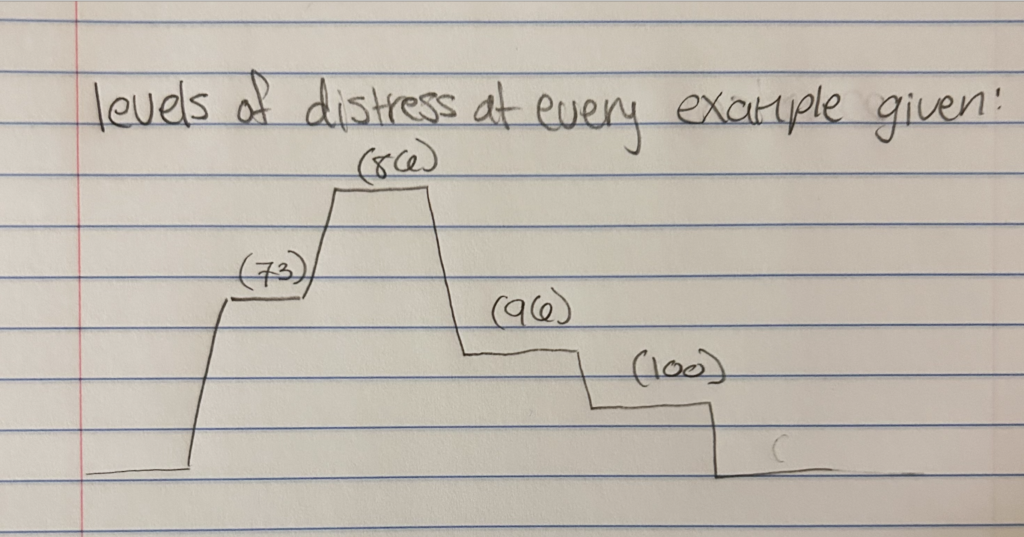
keyword: distressed

Herbert Richardson is distressed about his upcoming execution date (73)

→ he has a physical reaction and has haggard breath and is hopeless. He thinks that Stevenson is his last chance

Herbert’s wife is distressed when her husband is about to die (86)

→ her response is also physical, but she expresses it more fiercely through her desperate sobs and refusal to leave Herbert

The entire community is in despair after Walter’s case (96)

→ This is different because its a situation that only had a direct impact on one person, but the despair pervades the whole community. It was a burden to the community, along with a horrendous thing that happened to Walter

Stevenson experiences inspiration and hope in the midst of deep distress (100)

→ Stevenson meets with Walter’s family, and its evident that they’re all in deep despair and are very worried about Walter. However, even though Stevenson has to give up so much sleep and he’s so worn out, he finds inspiration from these people, even though there is distress there too. This example shows how both can exist at the same time.